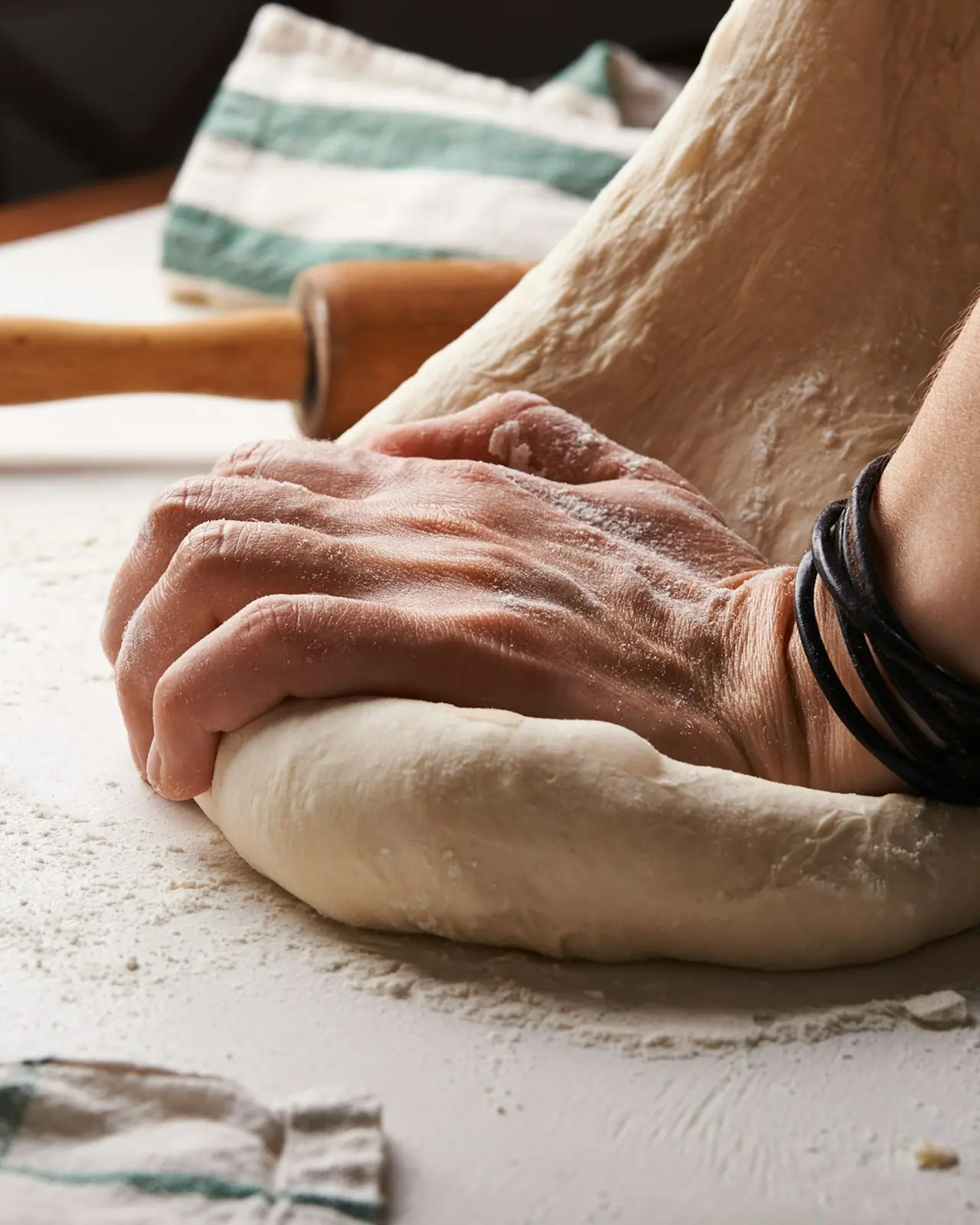
Dough
Pizza dough for a home oven.
Two bread-flour formulas: one you can mix and bake the same day, and one that stays in the refrigerator for 24 hours. Both make two balls of about 424 grams.
A quick pizza dough is mostly a decision about yeast and temperature. More yeast and a warm room get you to a bake in an afternoon. Less yeast and a cold refrigerator take about a day and taste less sweet and less yeasty. The flour, water, salt, and oil below stay in the same ratio either way, except the overnight batch uses 1 gram of instant yeast instead of 3 grams.
These are standard baker’s percentages for home pizza, not a report of a personal test. Flour brands, room temperature, and ovens change the result. If the dough feels stiff after the first rest, wet your hands on the next fold instead of dumping in a large handful of flour. If it feels slack, give it time to tighten before you add flour.
Same-day pizza dough
A 65% hydration bread-flour dough for two pizzas, mixed and baked the same day.
Ingredients
Weights are the recipe. Spoon measures are only a rough check: 500 g flour is about 4 cups, 10 g fine sea salt is about 1 2/3 teaspoons, 3 g instant yeast is about 1 teaspoon, and 10 g olive oil is about 2 teaspoons.
- 500 g bread flour (about 11.5–13% protein)
- 325 g water, cool
- 10 g fine sea salt
- 3 g instant yeast
- 10 g olive oil
Equipment
- Digital scale
- Large mixing bowl and cover
- Baking steel or baking stone
- Pizza peel, or a rimless sheet pan lined with parchment
Method
- Weigh 500 g bread flour into a large bowl. Stir in 10 g fine sea salt and 3 g instant yeast.
- Add 325 g cool water and 10 g olive oil. Mix until no dry flour remains, about 2 minutes. The dough will look shaggy.
- Cover the bowl and rest 20 minutes.
- With a wet hand, stretch one side of the dough over the center. Turn the bowl a quarter turn and repeat until all four sides have been folded. Cover 20 minutes, then repeat that set of four folds once.
- Cover and rest 30 minutes. The dough should feel smoother and a little puffier.
- Divide the dough into two equal pieces, about 424 g each. A small difference is normal if flour stays in the bowl. Shape each piece into a smooth ball.
- Set the balls in a lightly oiled, covered container. Rest 60 minutes at about 70 to 75°F (21 to 24°C). In a cooler kitchen, give them another 20 to 30 minutes. They should look slightly puffed and relax when pressed.
- Heat a baking steel for 45 minutes at 525°F (274°C), or a baking stone for 60 minutes at the same temperature. Shape and top one ball. On a steel, bake about 10 minutes. If you use parchment under the dough, bake 4 minutes, pull the parchment out, and bake about 6 minutes more. Bake the second pizza the same way. A cast-iron skillet needs the longer timing in the baking guide, not this 10-minute steel bake.
Active dry yeast, if that is what you have
Instant yeast can be stirred into the flour. Active dry yeast wants a head start. For the same-day dough, use 4 grams of active dry yeast in place of the 3 grams of instant yeast. Bloom it in 100 grams of the formula’s 325 grams of water, heated to 100–110°F (38–43°C), for 10 minutes. Use the remaining 225 grams of water cooler, so the finished dough lands near 75°F (24°C). Skip the bloom for the overnight dough and keep the instant yeast at 1 gram; active dry is a poor match for that small cold-ferment dose unless you already know the packet is fresh.
Flour
Bread flour in the United States is usually in the range of 11.5 to 13 percent protein. That strength is what lets a 65 percent dough stretch without tearing after a rest. Tipo 00 flour labeled for pizza is the flour in the Neapolitan recipe. It can be used here in the same 500 gram weight, but the dough often feels silkier and a little less chewy. All-purpose flour can work in a pinch; the crust will usually be less sturdy, so keep the water at 325 grams rather than adding more.
Overnight pizza dough
The same 65% dough with less yeast, refrigerated for 24 hours before baking.
Ingredients
Only the yeast changes. One gram of instant yeast is about 1/3 teaspoon.
- 500 g bread flour
- 325 g water, cool
- 10 g fine sea salt
- 1 g instant yeast
- 10 g olive oil
Equipment
- Digital scale
- Covered containers that fit in the refrigerator
- Baking steel or baking stone
Method
- Weigh 500 g bread flour into a bowl. Stir in 10 g fine sea salt and 1 g instant yeast.
- Add 325 g cool water and 10 g olive oil. Mix until no dry flour remains.
- Cover 20 minutes. Fold the dough from all four sides once, then cover another 20 minutes.
- Divide into two balls, about 424 g each, and place them in lightly oiled, covered containers.
- Refrigerate for 24 hours.
- Take the dough out of the refrigerator 75 minutes before you shape it.
- Bake one pizza at a time on a steel preheated for 45 minutes at 525°F (274°C), about 10 minutes per pizza. On parchment, bake 4 minutes, remove the parchment, and bake about 6 minutes more.
Why hydration, time, and temperature matter
Hydration is water divided by flour. Here, 325 divided by 500 is 0.65, or 65 percent. That is wet enough to stretch for a 12-inch pizza and dry enough to move off a peel if the dough is floured lightly. A higher percentage slackens the dough and can make the center soggy if the oven is not very hot. A lower percentage, like the 62 percent in the New York dough, rolls out thinner and holds a larger slice.
Salt is 2 percent of the flour weight, 10 grams. It seasons the crumb and slows the yeast slightly. Yeast is the clock: 0.6 percent instant yeast (3 grams) for the same-day dough, 0.2 percent (1 gram) when the dough will sit cold for a day. Oil at 2 percent (10 grams) tenderizes the crumb and helps it brown in an oven that tops out well below a pizza oven.
Temperature decides whether those clocks are honest. The room-temperature rests assume about 70 to 75°F (21 to 24°C). A 65°F kitchen needs more time. A dough that overshoots 80°F (27°C) during mixing will ferment faster and can taste sharply yeasty, so use cool water when the kitchen is warm.
| Dough | Flour | Water | Salt | Yeast | Oil | Schedule |
|---|---|---|---|---|---|---|
| Same-day, this page | Bread flour | 65% | 2% | 0.6% instant | 2% | About 2 hours 25 minutes before the oven |
| Overnight, this page | Bread flour | 65% | 2% | 0.2% instant | 2% | 24 hours cold, then 75 minutes out of the fridge |
| Neapolitan | 00 pizza flour | 65% | 2.6% | 0.2% instant | None | 24 hours cold |
| New York | Bread flour | 62% | 2% | 0.4% instant | 3% | 24 hours cold, plus sugar at 2% |
A thinner crust is a portion change, not a new formula. Use about 350 grams of dough for a 14-inch round and leave the rest for a smaller pie. Stretch only after the ball relaxes. If it snaps back, cover it 10 minutes and try again. Forcing it with a rolling pin presses out the gas the rest just built.
What this page does not try to be
Gluten-free pizza crust, cauliflower crust, and crusts built on cheese or ground meat are different products. They do not use this hydration, and they should not be made by deleting the wheat flour from the list above. Sourdough pizza dough depends on an active starter and a longer, less predictable rise. If you want that style, keep it as its own formula rather than calling this yeasted dough sourdough.
Dough without yeast is a different texture again, usually a biscuit-like flatbread. This publication’s pizzas are leavened.
Storage, freezing, and reheating
The same-day dough is meant to be baked the day it is mixed. You can hold the balled dough in the refrigerator up to the next day; expect more rise and a looser ball. The overnight dough should be baked within about 48 hours of mixing, 24 hours being the schedule written above. If a ball smells sharply of alcohol or collapses into a puddle, bake it sooner or discard it. Do not try to rescue it with a lot of extra flour.
To freeze either dough, oil the balls lightly, wrap them, and freeze for up to 2 months for best quality. Thaw overnight in the refrigerator, then temper 60 to 90 minutes before shaping. U.S. food-safety guidance is to refrigerate perishable cooked pizza, sauce, and cheese within 2 hours, or within 1 hour if the room is warmer than 90°F (32°C). Reheat leftovers until they reach 165°F (74°C). Raw flour is not a ready-to-eat food, so do not taste unbaked dough.
Baked pizza from this dough keeps 3 to 4 days in the refrigerator. Reheat slices in a skillet or a 375°F (190°C) oven until hot. A microwave softens the crust. However you reheat, the food-safety target is 165°F (74°C).
If the dough misbehaves
- It will not stretch. It needs more rest, or the kitchen is cold. Wait 10 minutes. Do not add water at this point unless the dough was dry and stiff from the first mix.
- It spreads into a puddle. The dough is over-fermented or was mixed too warm. Bake it sooner, on parchment, and use less yeast next time.
- The bottom stays pale in 10 minutes. The steel or stone was not preheated for the full 45 or 60 minutes, or the rack was too high. The baking guide covers rack position.
- The rim is blond and the center is done. Heat was too low, or the pizza was wet from sauce. Use the sauce amounts on the recipe you are baking, and preheat longer.
More symptoms are collected in the troubleshooting guide.
Common questions
Can this dough use active dry yeast?
Yes, in the same-day recipe. Use 4 g active dry yeast in place of 3 g instant yeast. Stir it into 100 g of the formula water at 100 to 110°F (38 to 43°C) and wait 10 minutes. It should look foamy. Add it with the remaining 225 g of cooler water. If it does not foam, the yeast is not active. This bloom adds about 10 minutes to the timeline.
Why are the recipes written in grams?
A cup of flour can vary by several dozen grams depending on how it is scooped. Salt brands also differ by volume. The gram weights keep the hydration and the salt level where the method expects them.
Is this a sourdough or gluten-free crust?
No. Both formulas use wheat flour and commercial yeast. A sourdough crust needs a starter and a different schedule. A gluten-free crust uses starches and binders and cannot be made by swapping the flour in this dough one for one.
How thin can I stretch it?
One 424 g ball is written for a pizza about 12 inches across. For a thinner 14-inch round, use about 350 g of dough and expect the rim to be less puffy. The extra dough can become a smaller second pizza.